
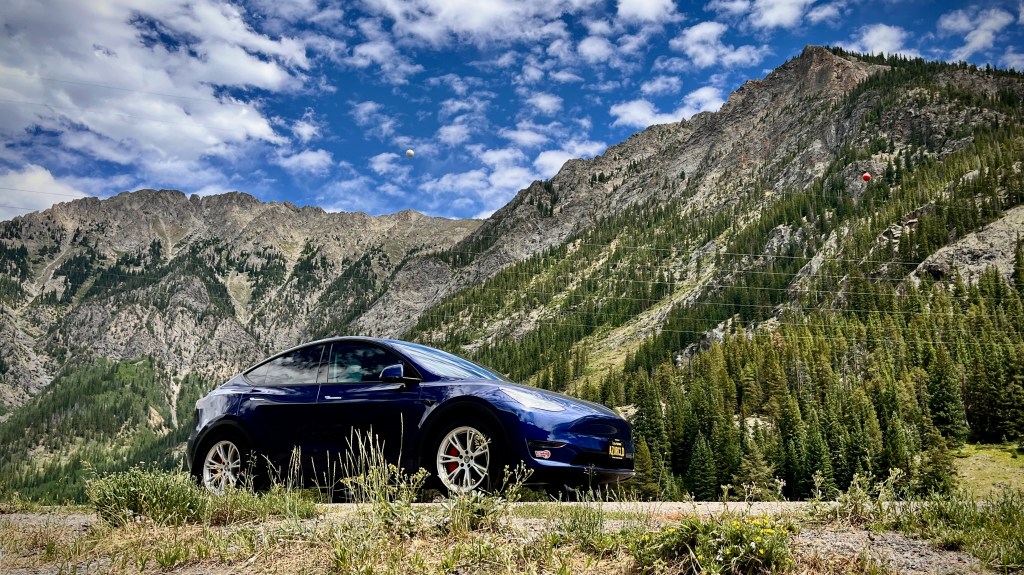
One of the key parameters people think of when you say “EV” is range. And a cornerstone measurement of EV range is how efficient the car is when you drive it. Many EVs claim somewhere between 200 to 300 miles of range. But there are a few problems with this number. First, it’s not real. It’s a best case estimate from driving the EV on a track at steady state from 100% to 0%. This is where we call the range meter a “guess-o-meter.” The car gives a best guess based on perfection. Some of the computers also considers your driving style. Some cars like the Tesla can include real time weather and traffic conditions when it makes its guess. That helps. As a driver, you need to think about these parameter as you plan trips. This is important regardless of what “HAL” is trying to tell you.
Range estimates are a lie. That is a fact. Its a lie of omission. What do I mean? I mean that if you read the owners manual, Tesla says not to drive below 20% state of charge (SOC). They also advise against consistently charging to 100%. Tesla prefers you to be at 80% SOC to maximize your battery lifespan. So my Long Range Model Y is rated at 300 miles, more or less. So 80% translates to 240 miles of range right? Nope.. you need to whack off 20% more at the low end. This is about 60 miles of the mythical 300. So now your “real” range is about 180 miles of range. Which assumes 100% efficiency which rarely happens. I get about 90% efficiency which is considered exceptional with most drivers getting more in the neighborhood of 80-85% efficiency. If it’s cold outside, you lose another 10-30% depending which EV and how old it is. The newer Teslas for example use heat pumps which helps to reduce cold loss to about 10%. I can speak from experience. Tesla is good at guessing range, but it struggles in states like Utah. The speed limits there are 80 mph compared to the more common 65 mph. It also struggles a bit with significant elevation changes like, say , the Rockies. I never trust the nav system when it says I’ll arrive at 10% SOC. If I have any choice at all, I won’t leave till I can work out a 20% SOC on arrival. It has been a lifesaver a few times. I had a case in my older Model 3 without the heat pump. I left at 95%. This was stated to be 190 miles of range. I should arrive at my destination at 20% SOC right?. However, snow started, and the high speed limit impacted my range. The nominal inefficiency of an older EV also contributed. I ended arriving at the supercharger at 7% and not a little stress. The guess-o-meter was off a considerable margin when it was all said and done.
So what is a driver to do? It ends up being a combination of things to solve this problem. First is just experience with the car and how you drive it. EVs are very sensitive to driver style. If you remember driving a sports car with a gas engine, it’s a lot of “Fun” to go ripping around corners and treating green lights as mini races. With an EV, its all of that on steroids. The torque of an EV is such that stop light acceleration is greater than many sports cars. And if you have it, you tend to use it unless you put in deliberate effort to not do it. And like they say, speed costs money, pay me now or pay me later. In the EV world, speed costs range very quickly. Accelerating rapidly will wear out your tires sooner. It will also reduce your range significantly if you do it often.
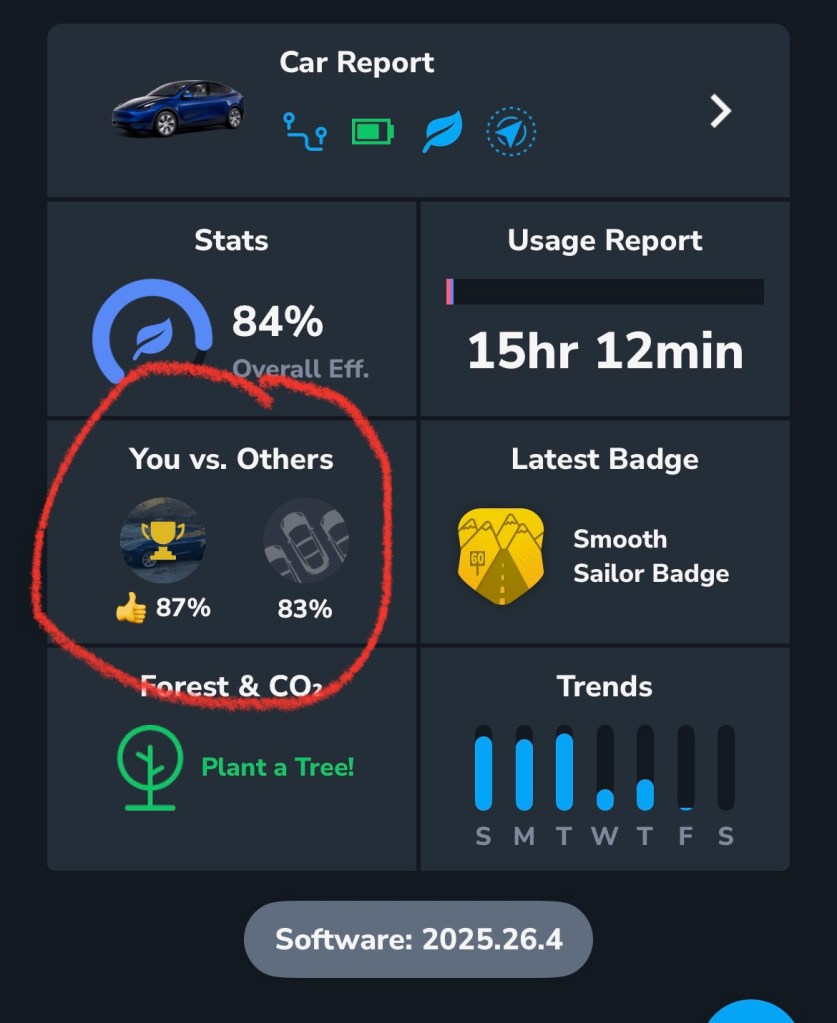
There is software to help track all of this data and then some. I use a package called “TezLab.” It taps into the data captured by Tesla. This generates pretty cool reports on driving, charging, range, and efficiency.
In the first picture, you see the overall information. How long of time the report is for. The trends over the last week. My average efficiency in percent or in Wh/mi ( watt hours per mile). The next two images are for a specific trip which in this case from Williams AZ to Kingman AZ. It gives total time, efficiency which was 90% and more. I can even pull up a chart that shows the battery usage over time of the trip.
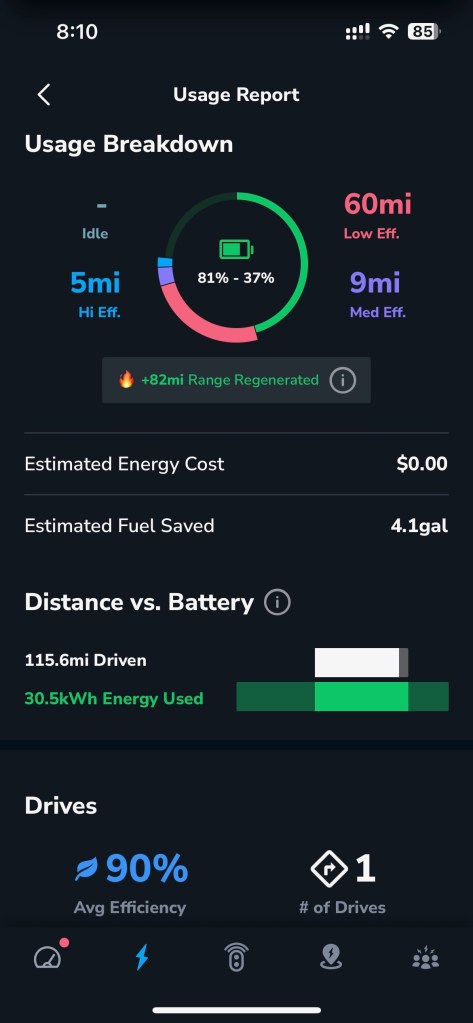
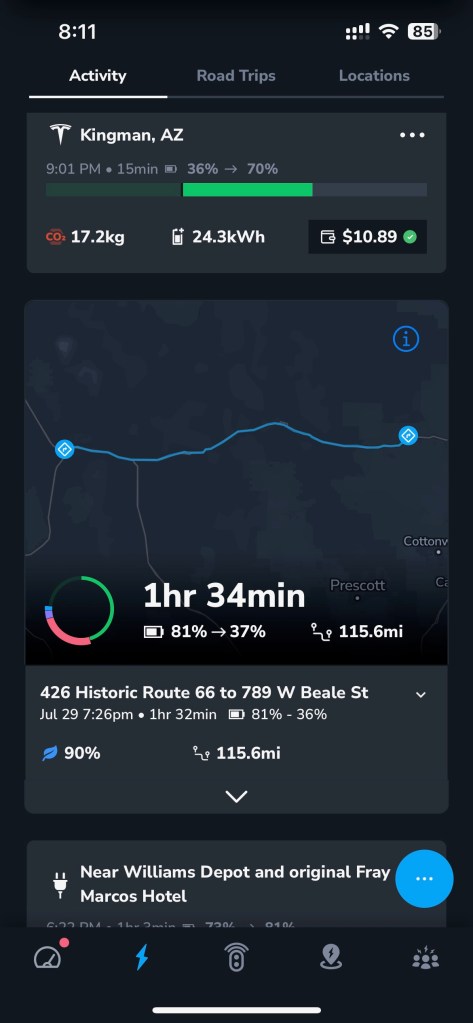
As you can see, my Model Y performed very well on efficiency. This was with 3 adults and a full load of luggage. It maintained this efficiency despite the average speed of 75 mph. This level of efficiency is what separates out all the brands of EVs. Some are just remanufactured ICE cars with an electric motor. Others are actually engineered from the ground up to be an EV. Tesla engineering is very good at this as is one of its competitors called Lucid. Both companies take great pride in how efficient their EVs are in operation. Other companies struggle with it.
According to RecurrentAuto, Lucid specializes in this type of research. It is the most efficient EV Sedan in the market today. The Tesla Model 3 LR and Model S are runner ups as is the BMW i4 and Ioniq 6.
The most efficient EV SUV is the Tesla Model X. The Polestar 3, Acura ZDX, and Jeep Wagoneer are runner-ups.
The most efficient EV Crossover is the Lexus RZ. The Tesla Model Y, Ioniq 5, and Kona EV are runner-ups.
With these various models, it comes down to price. Perceived value for the consumer is also important when you shop for one. They all have strengths and weaknesses beyond the raw efficiency rating. However, the rating is a good place to start your evaluation.
I’ve had my 2024 Y for 1.5 years now and have completed two 2,000 mile trips plus a number of shorter trips all over the US. Before this Y, I had a 2019 Model 3. I did several 1,500 mile plus trips with it. This was despite the short range of 200 miles at best case. I can say that even if the Y is not the top efficiency rated car ( cross over?), it has features that float it to the top when you look a the total package. The nav system is very good. I don’t completely trust it. However, with “trust but verify” and spending some time, I have found it to be more accurate than just about any other factory nav system out there. The range guess-o-meter when you pay for the premium connectivity is very good. Not perfect as I alluded to near the beginning but very good. My BMW range accuracy was much worse at considering environmental conditions such as extreme heat or cold.
Tesla’s software updates are arguably the best currently in the automotive world. I get updates almost on a monthly basis. Up to now, I have not had to take my 3 or Y into the service center. I’ve had no issues like a botched update or failure to receive an update. That is a world of difference from some of the other auto makers. The last few updates have included fixes and improvements to the reporting of range and efficiency. I have seen the accuracy increase a bit. My Chevy bolt while being a 2021, has had zero updates since the last battery update over 3 years ago. And that only occurred when the car was taken to the dealer despite paying for GM’s premium connectivity.
Here is a version of the blog post set up as a podcast via Google’s NotebookLM application. Take a listen and let me know what you think.

Leave a comment